Shopify's AI is everywhere now - here's what actually changed
News
September 24, 2026
Olya Kryvonos

Shopify Magic is the built-in AI toolkit every merchant already has access to — product descriptions, image editing, email content, auto-tagging, SEO metadata. It's grown fast: Shopify now counts 150+ AI-powered features across content generation, customer service, and store management, and UK merchant adoption is reportedly sitting around 93%, whether they're actively using it or actively planning to.
The parts merchants seem to rate highest are the boring-but-brutal time sinks: SEO metadata generation and product description drafting, with some merchants reporting 4–6 hours saved a week just on descriptions. The parts that still need a human hand: bulk content generation and keeping tone-of-voice consistent across a large catalog. Magic is a strong first draft machine. It's not yet a brand voice machine.
Sidekick is the more ambitious piece — Shopify's conversational AI built into the admin. Ask it how your store performed last week, get it to draft content, or increasingly, tell it to just go do something: create a discount code, set up an automation. The impact shows up in the time it gets back, not just the tasks it completes — Maggy London reported an 80% cut in reporting time after putting Sidekick to work on their store analytics. It's built for the merchant who finds the Shopify admin genuinely overwhelming, not the one who lives in it.
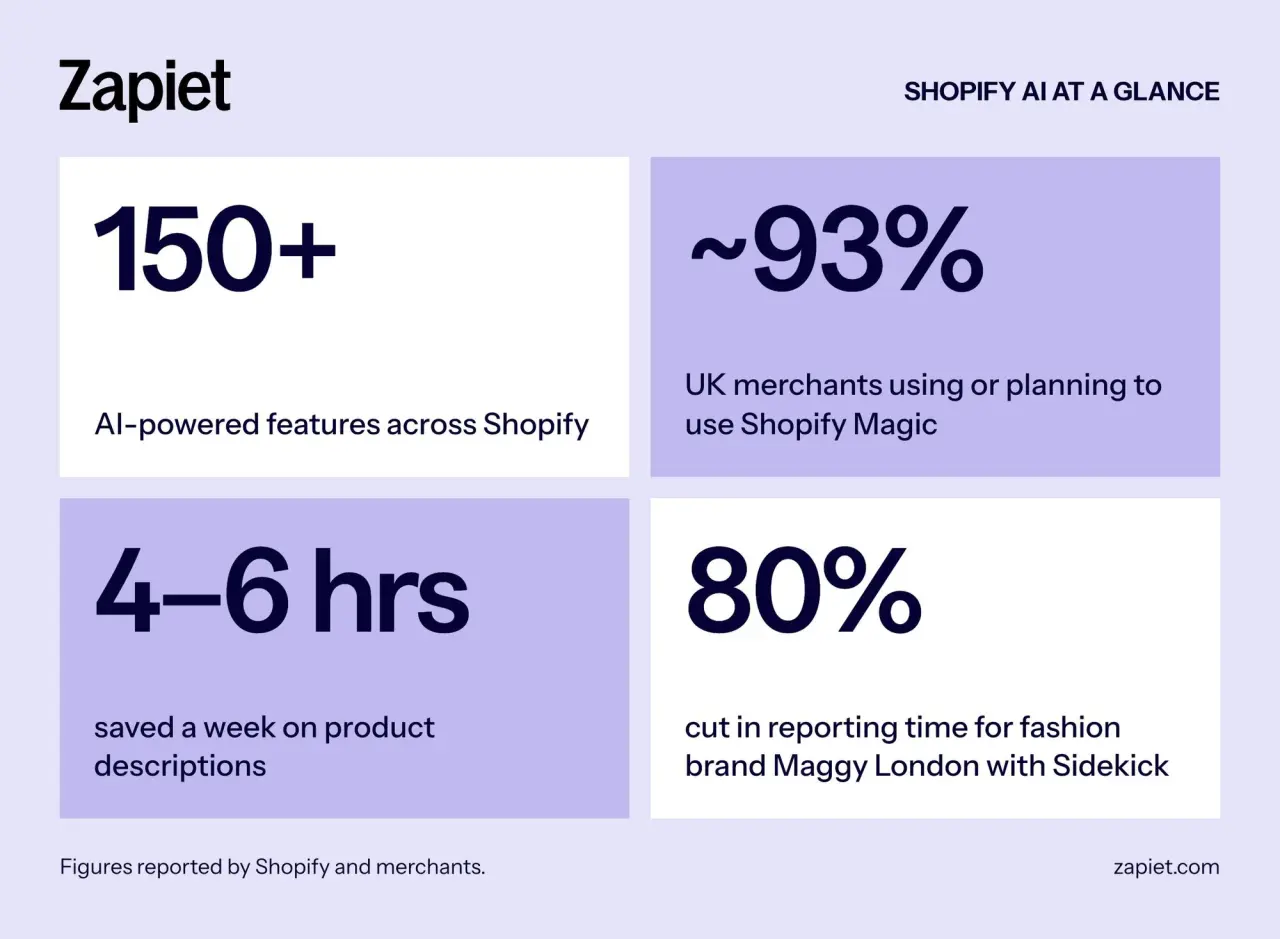
Less busywork, more store: Shopify's AI at a glance.
The real shift: Sidekick goes everywhere
The headline news is the Spring '26 Edition, themed "Everywhere" — over 150 updates, with agentic commerce as the center of gravity. The most immediately useful part for day-to-day store management: Sidekick now works throughout the admin, not just in a chat panel off to the side. Ask it a natural-language question about your data and analytics, tell it to build an automation — like auto-tagging customers based on spending habits — or have it walk you through a settings change you'd otherwise have to hunt for. New App Extensions also let third-party tools plug into Sidekick directly.
Two more pieces worth knowing about: Campaign Autopilot, an early-access feature in the growth dashboard that lets you create, run, and monitor AI-driven marketing campaigns across Meta Ads and the Shop app without jumping between platforms. And an AI Sales Associate built into Shopify Inbox, which answers buyer questions, recommends products, and handles order tracking directly inside customer chats — a genuinely new surface, not just an admin convenience.
For a lot of store automation, this is genuinely great news. Review requests, low stock alerts, welcome flows, basic discount logic, customer tagging — the stuff that used to mean either learning Flow's builder or paying someone who already had. Now it's a sentence in a chat window, wherever you happen to be in the admin.
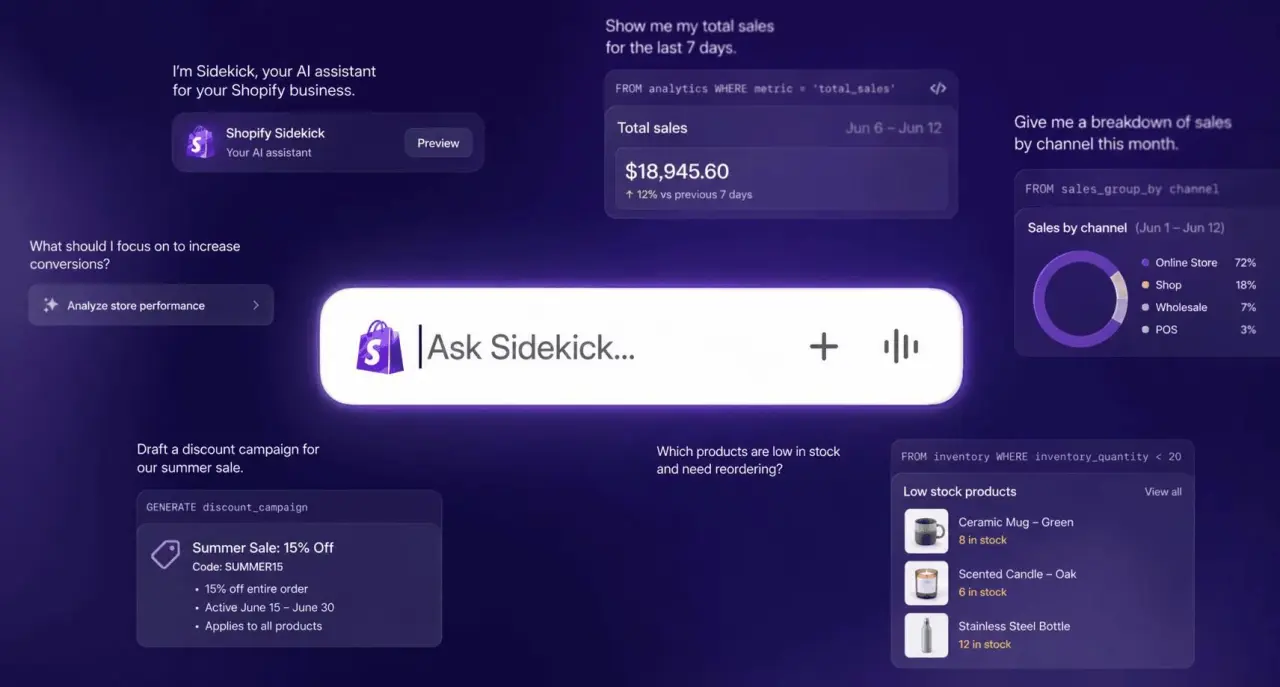
Automations used to take a builder. Now they take a sentence.
So what should you actually do with this?
The guidance floating around the merchant community right now is a good one: exhaust Shopify's free AI tools before you pay for anything. Magic reportedly handles somewhere around 50–60% of a store's content needs on its own, and whatever it can't do tells you precisely where to spend money next — you're not guessing at a gap, Magic shows it to you.
The same logic applies channel by channel. On email, Shopify Email with Magic is a genuinely fine starting point, but merchants doing $20,000+ a month in revenue tend to outgrow it and move to something like Klaviyo once segmentation and lifecycle flows get more demanding than Magic was built for. The pattern is worth watching for across the rest of your stack too: let Shopify's free layer do the general, high-volume work, and treat the specific point where it starts to strain as your signal for where a specialized tool actually earns its cost.
Sidekick showing up everywhere in the admin is the same idea applied to automation instead of content. It's very good at the kind of workflow with a handful of clean variables — trigger, condition, action, a tag applied based on spend. It's a different story once the logic gets genuinely operational: multi-location inventory, geography-based rules, anything where the "if this, then that" has a dozen real-world exceptions baked in. That's less a knock on Sidekick than a reminder that conversational AI is a brilliant front door, not yet a replacement for tools purpose-built around a specific operational problem.
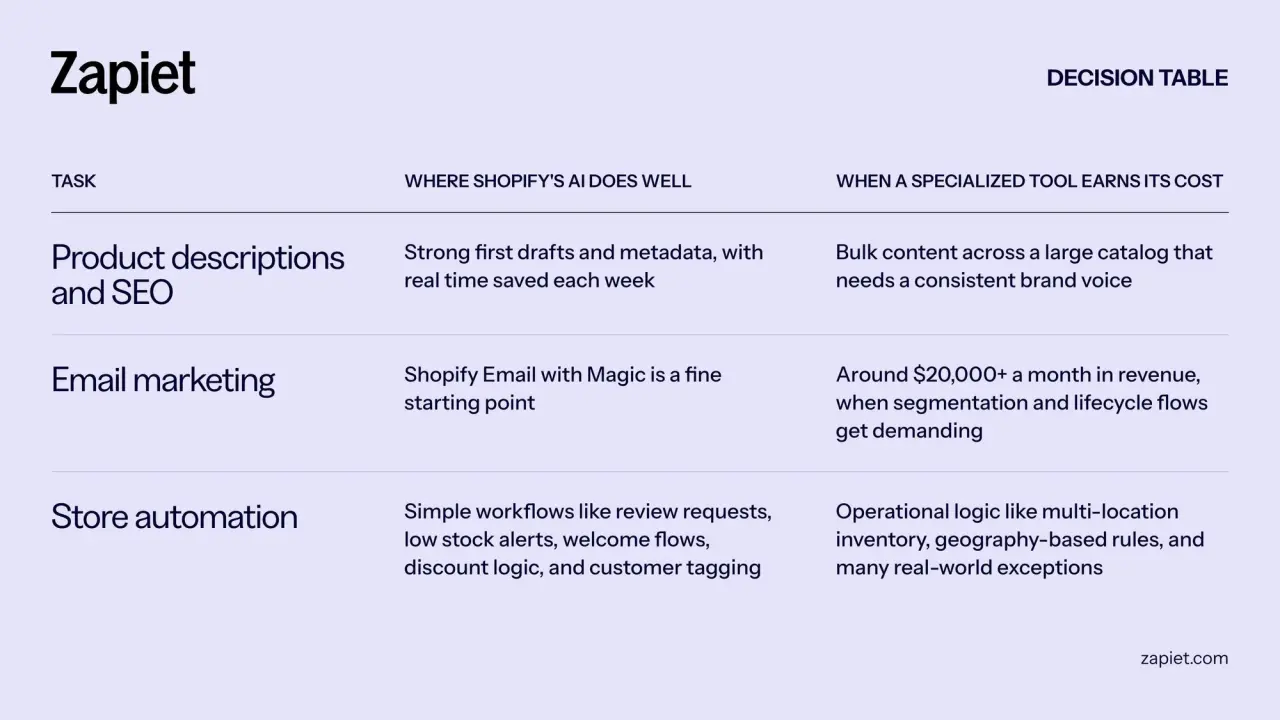
Your signal to upgrade is where Shopify's AI starts to struggle.
The bigger picture
What's actually happening here is Shopify collapsing the distance between "having an idea" and "shipping it" — and doing it everywhere at once: describe an automation and Sidekick builds it, describe a campaign and Autopilot runs it, a buyer asks a question in chat and gets a real answer without a human touching it. That's a real shift for merchants who've never touched the Flow builder, run paid campaigns solo, or staffed live chat. It doesn't replace deep, domain-specific tooling — it just means the free tier keeps eating a little more of the general-purpose work, and the tools worth paying for are increasingly the ones solving something Shopify's own AI genuinely can't reach yet.
Worth testing this yourself: open Sidekick, describe one automation you've been meaning to set up, and see how close it gets on the first try.
Share this post