Shopify vs Uber Eats: which ordering setup is better for restaurants?
Insights
August 5, 2026
Andrew Cargill, Founder of Zapiet
Uber Eats is a marketplace: it can help restaurants reach customers searching for food on Uber’s platform, with ordering and delivery managed through the Uber Eats ecosystem.
Shopify is your own online storefront: with a restaurant ordering app such as Zapiet Eats, you can sell directly through your website and manage menus, pickup, local delivery, scheduled orders, and restaurant operations in one place.
For many restaurants, the best approach is not choosing one forever. Use marketplaces such as Uber Eats to reach new customers, while building a direct ordering channel on Shopify for repeat customers and orders you want to own.
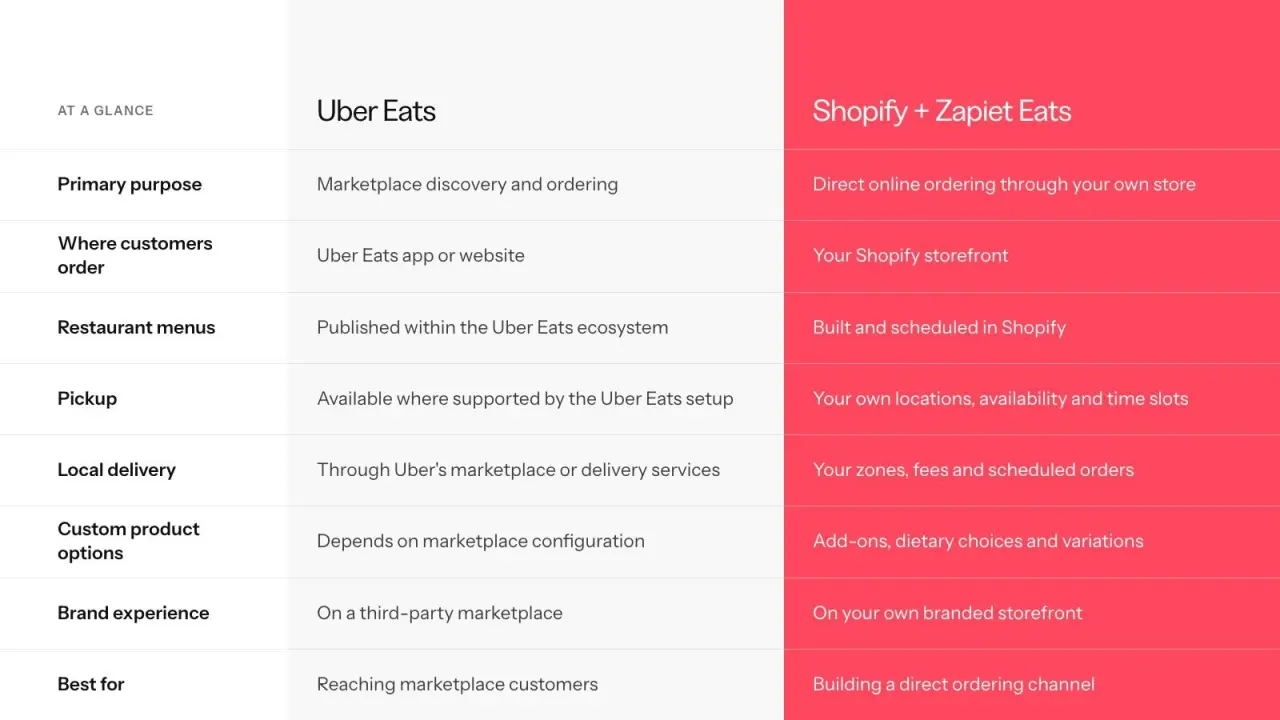
Uber Eats and Shopify do different jobs. Availability, fees and delivery options vary by market, Shopify plan and provider configuration.
When Uber Eats makes sense
Uber Eats can be a useful channel when your priority is customer discovery.
Customers already use the Uber Eats marketplace to search for restaurants and place delivery or pickup orders. Being present there may help a restaurant reach people who have not visited its website before. Uber also provides access to a large delivery network in supported markets.
Uber Eats may be a good fit if you:
- Want to reach customers who are already searching for food on a marketplace
- Need an additional acquisition channel beyond your website
- Prefer to outsource parts of dispatch and delivery operations
- Are comfortable evaluating marketplace fees against the incremental demand they generate
- Want to test delivery demand before building a direct ordering operation
The trade-off is that a marketplace channel gives you less control over the complete customer journey. Fees, visibility, customer communication, and platform rules can vary by market and agreement. Review the commercial terms for your location rather than relying on generic fee percentages.
When Shopify + Zapiet Eats makes sense
Shopify with Zapiet Eats is designed for restaurants, cafés, bakeries, and food businesses that want to take orders through their own storefront.
Zapiet Eats helps turn a Shopify store into a restaurant ordering system with tools for:
- Menu design and seasonal menu scheduling
- Real-time order management
- Pickup and local delivery
- Delivery fees based on distance or order value
- Customer-selected dates and time slots
- Dietary restrictions, allergens, and product options
- Dine-in ordering and table reservations
- Product bundles and add-ons
- Order status and customer reviews
- Reporting on products and order performance
This setup may be a better fit if you:
- Already have a Shopify store and want to add restaurant ordering
- Want customers to order directly from your website
- Need more control over pickup windows, delivery zones, fees, or preparation times
- Want to build repeat business through your own customer experience
- Operate multiple food locations or more complex menus
- Want ordering, products, customers, and operations connected to Shopify
The biggest difference: marketplace demand vs. direct demand
The central difference is not simply “Uber Eats versus Shopify.” It is where demand comes from and who controls the ordering experience.
Uber Eats can put your restaurant in front of people who are browsing a marketplace. Shopify gives you a place to convert demand you generate yourself—from your website, email, social media, search, packaging, loyalty program, and in-store promotion.
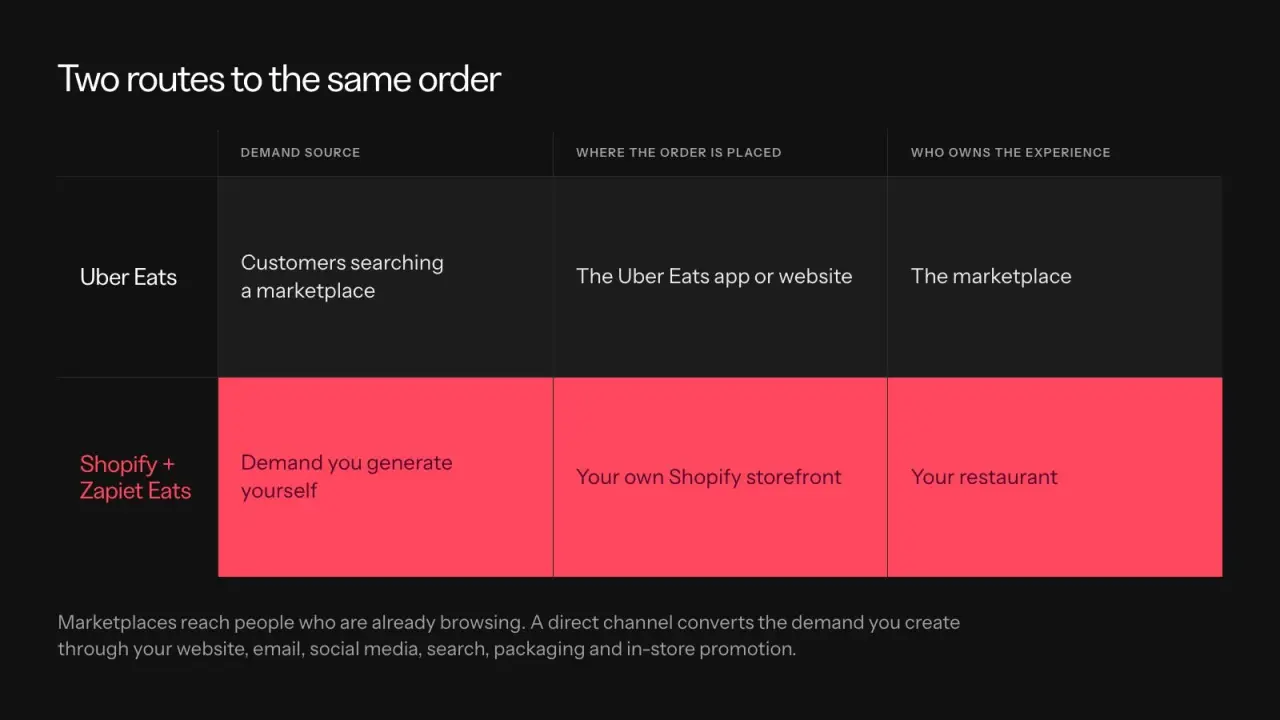
Where demand comes from, and who controls the ordering experience.
A direct channel can also make it easier to create an experience that matches your brand. Customers can browse your menu, choose pickup or delivery, select an available time, customise products, and check out without being redirected to a third-party marketplace.
The economics depend on your setup. A direct Shopify order still has payment processing, app, delivery, and other operating costs. However, it lets you compare those costs directly with the value of the order instead of assuming every order needs to come through a marketplace.
Can you use Uber Eats and Shopify together?
Yes. In many cases, using both can be the most practical approach.
A restaurant might use Uber Eats for marketplace discovery and new-customer acquisition, while using Shopify + Zapiet Eats for:
- Orders from the restaurant’s website
- Repeat customers
- Pre-orders and scheduled pickup
- Larger catering or family orders
- Branded promotions and loyalty campaigns
- Customers who prefer to order directly
- Direct delivery workflows with a chosen delivery provider
This gives the business more than one source of demand without making the marketplace the only way customers can order.
What about Uber Direct on Shopify?
Uber Eats and Uber Direct should not be treated as the same product.
Uber Eats is the consumer-facing marketplace. Uber Direct is Uber’s white-label delivery service for orders that originate through a merchant’s own sales channels.
Uber says Uber Direct for Shopify supports one-hour, same-day, and scheduled delivery for Shopify Plus merchants in the U.S., Canada, and France, with more regions expected to follow. Availability and eligibility can change, so merchants should confirm the current terms and market coverage directly with Uber.
Zapiet’s ordering and delivery tools can help manage the customer-facing ordering rules—such as pickup, delivery availability, time slots, and fees—while a supported last-mile provider handles the delivery itself. See Uber Direct on Shopify: choosing the right setup for more detail.
Which setup is right for your restaurant?
Choose Uber Eats if:
- Your main goal is reaching new customers through a marketplace
- You value access to Uber’s existing customer and courier network
- You are willing to trade some control and margin for marketplace demand
- You want to validate delivery demand quickly
Choose Shopify + Zapiet Eats if:
- You want customers to order directly from your website
- You need restaurant-specific menu and scheduling tools
- You want control over pickup, delivery zones, fees, and availability
- You want your ordering experience to remain inside your brand
- You want to build a repeat-order channel you can develop over time
Use both if:
- You want marketplace reach and a direct channel
- You serve both new and repeat customers
- You want to reduce dependence on one acquisition source
- Your operation can support different order channels with clear workflows
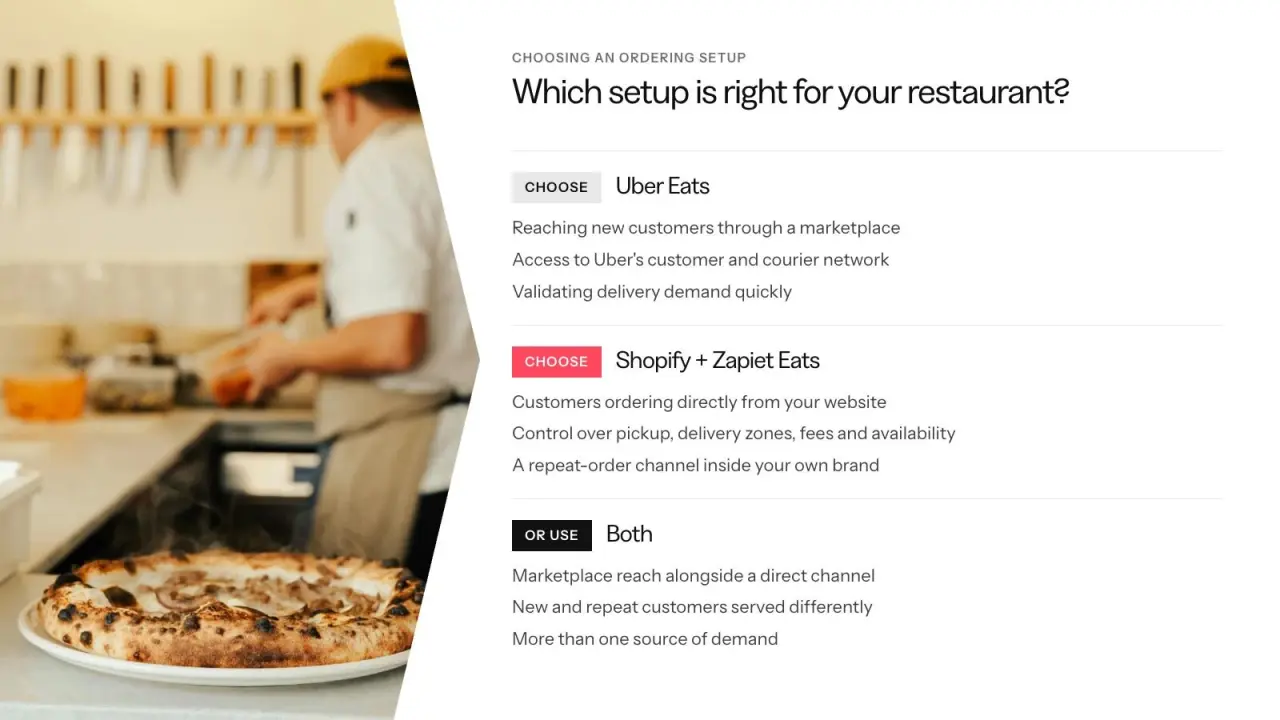
Start from the job you need the channel to do.
How Zapiet Eats helps restaurants take orders on Shopify
Zapiet Eats gives Shopify food businesses the tools to manage ordering around the way their operation actually works.
Customers can see available options, choose pickup or delivery, select a suitable time, and order from the restaurant’s own storefront. Teams can manage menus, order details, locations, availability, and delivery rules in the Shopify environment they already use.
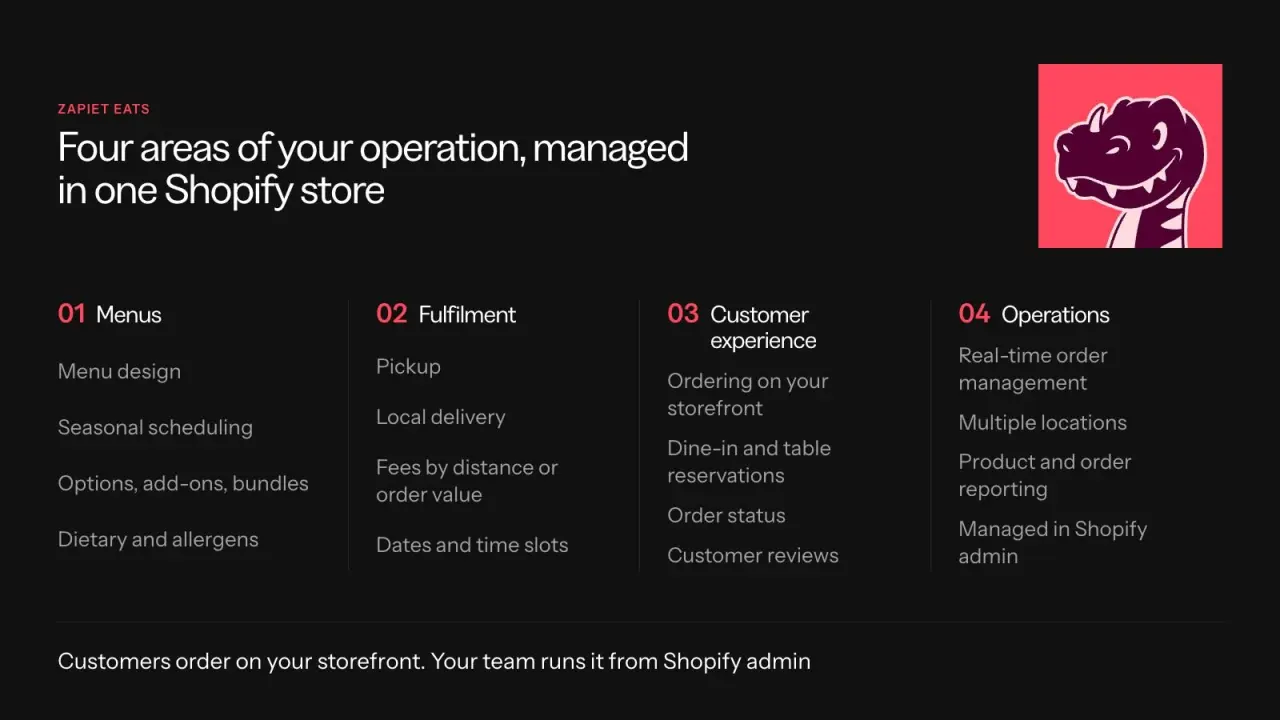
Menus, fulfilment, customer experience and operations, managed in one Shopify store.
The result is a direct ordering foundation for restaurants that want more than a generic ecommerce checkout—without forcing customers to leave the brand’s website to place an order.
Try Zapiet Eats for free
Turn your Shopify store into a restaurant ordering experience with menus, pickup, delivery, scheduling, and order management.
Frequently asked questions
Is Shopify better than Uber Eats for restaurants?
It depends on the job you need the channel to do. Uber Eats is built around marketplace discovery and ordering. Shopify, combined with a restaurant app such as Zapiet Eats, is built around your own storefront and direct customer journey. Many restaurants use both for different purposes.
Is there a Shopify Uber Eats integration?
The answer depends on whether you mean Uber Eats marketplace orders or Uber Direct delivery. They are different services and have different availability and integration options. Confirm the current Shopify, Uber, and app requirements for your market before choosing an implementation.
Can I take direct orders on Shopify without Uber Eats?
Yes. A restaurant can use Shopify with a restaurant ordering app to sell directly through its own website. Zapiet Eats supports restaurant menus, pickup, local delivery, scheduling, product options, and order management.
Does Zapiet Eats deliver the orders?
Zapiet Eats manages the ordering and fulfillment rules inside Shopify. Delivery may be handled by the restaurant’s own team or a supported last-mile delivery provider, depending on the merchant’s setup and market.
Can I offer pickup and delivery at the same time?
Yes. Zapiet Eats is designed to support pickup and local delivery workflows, including availability, fees, and customer-selected time slots.
Should a restaurant stop using Uber Eats?
Not necessarily. Uber Eats can be valuable for discovery and incremental demand. A stronger long-term approach for many restaurants is to keep marketplace access while also building a direct channel through the restaurant’s own website.
What is the difference between Uber Eats and Uber Direct?
Uber Eats is a consumer marketplace for finding and ordering from restaurants. Uber Direct is a white-label delivery service that can fulfill orders placed through a merchant’s own channels, where available.
Share this post