Stop feeding the platforms. Own your Orders.
Insights
June 12, 2026
Olya Kryvonos
The "order direct" moment is here
Research consistently shows that hospitality businesses lose between 15–30% of their revenue to third-party platform fees. That's not a small number. For a café doing solid annual revenue, that's a significant chunk walking out the door every single year — money that could go toward better ingredients, more staff, or simply staying open.
At this point, a fair question: what if you still need delivery? Does going direct mean giving up that capability?
Not at all. And this is where it gets interesting.
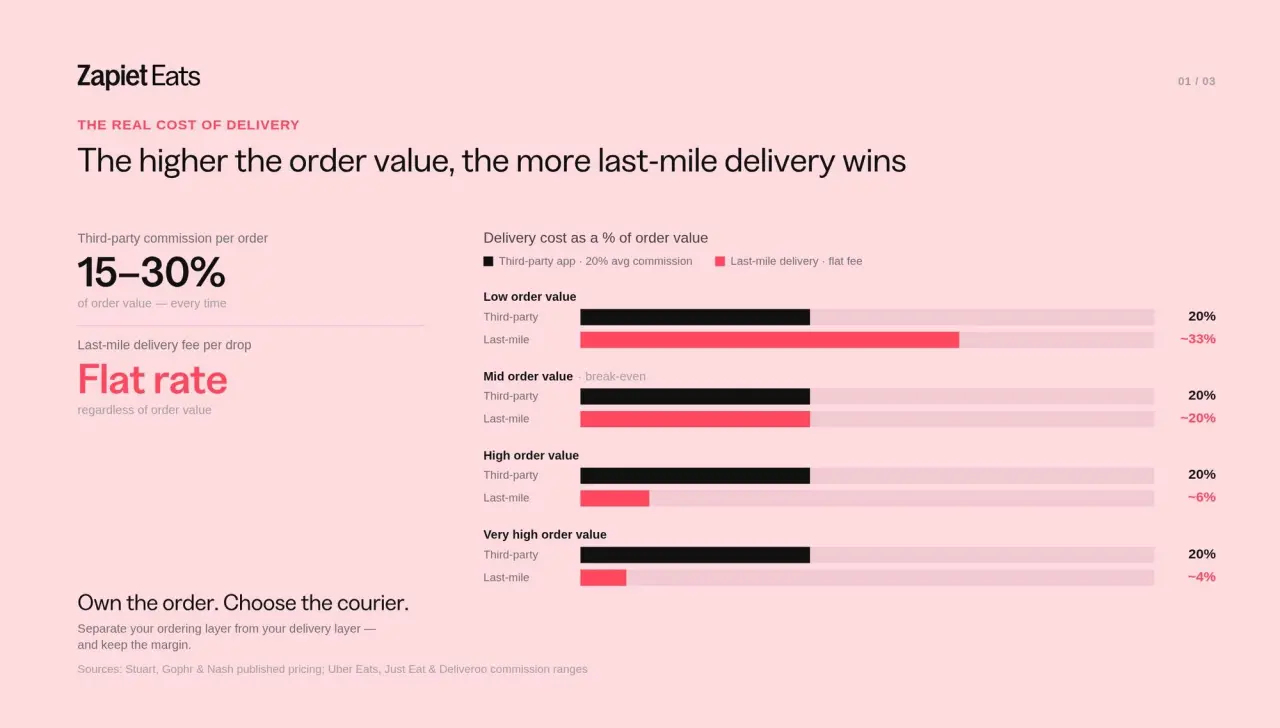
Third-party apps bundle ordering and delivery together — and charge you for both. But you don't have to buy them as a package. Last-mile delivery (LMD) companies like Stuart, Gophr, and Nash charge a flat fee per drop — typically a few dollars or euros depending on distance and volume. That's it. No commission. No percentage skimmed off your order value.
On a mid-sized order, Uber Eats and its equivalents take 15–30%. An LMD courier charges a flat rate — and the higher your average order value, the more the flat-fee model wins. On a large order, you could easily save 10–15% of revenue on that single transaction alone.
The smarter model isn't "no delivery." It's separating the ordering layer from the delivery layer — owning the first, and choosing the best provider for the second.
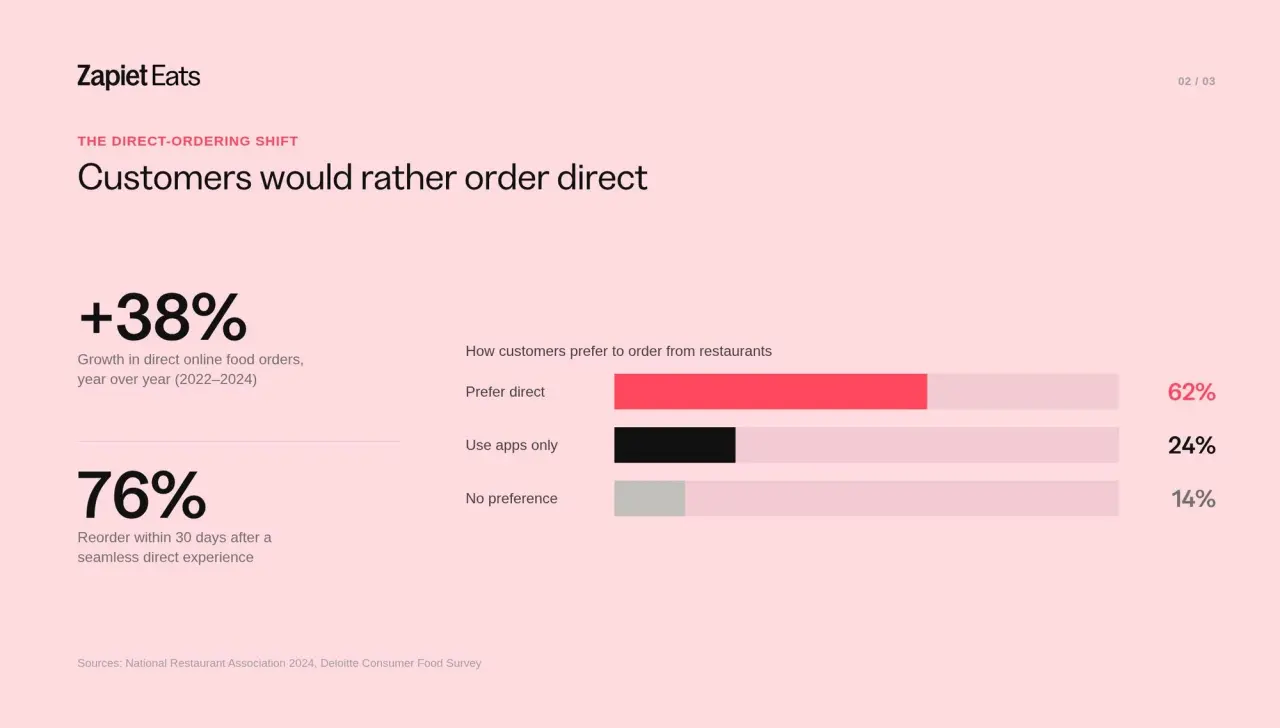
But the shift toward direct ordering isn't just about saving money. It's about owning the relationship.
When a customer orders through a third-party app, the platform owns the data. They own the re-marketing. They own whether your restaurant appears at the top of the search results next week or gets buried. You get a transaction. They get a customer.
When a customer orders directly through your own store, you get both.
Why most Shopify food merchants are leaving money on the table
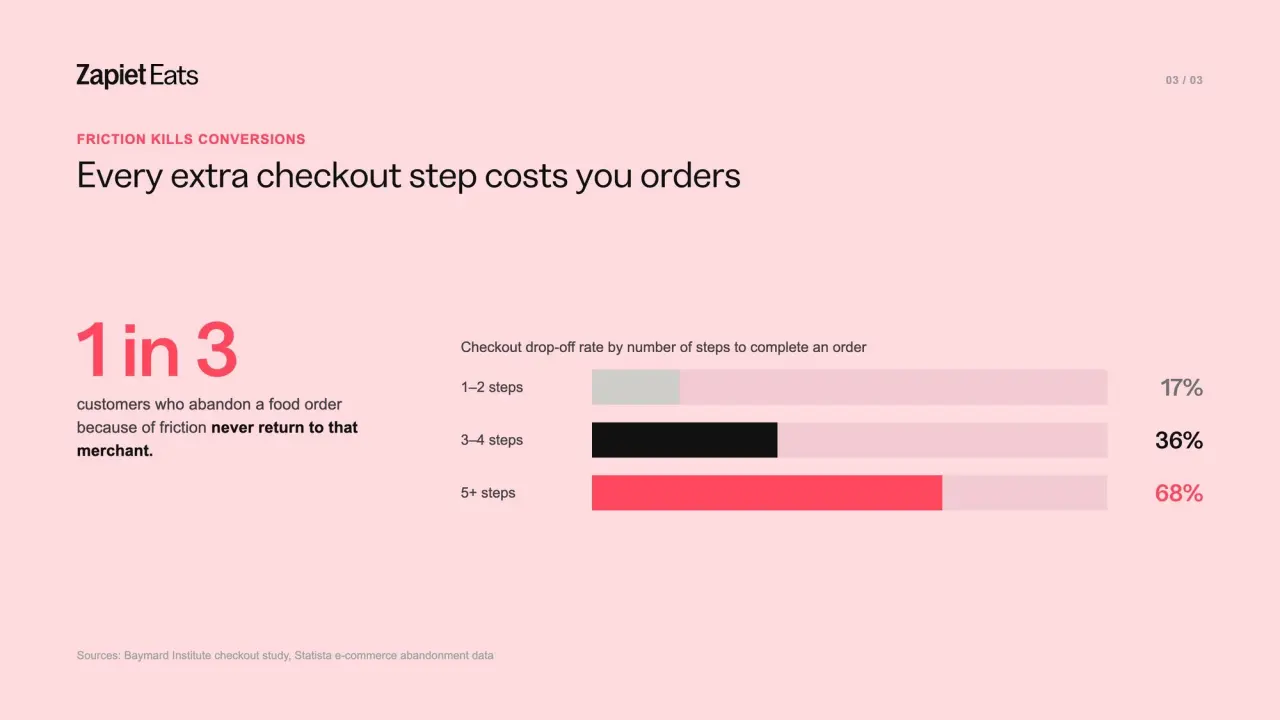
Here's the thing: a lot of restaurants and cafés are already on Shopify. They're using it for merchandise, gift cards, or packaged goods. But when it comes to food orders — hot drinks, baked goods, set menus, meal kits — they're either sending customers to a separate ordering platform or, worse, managing it through DMs and phone calls.
That friction has a real cost. Every extra step between "I want that" and "order placed" is a customer you risk losing.
The merchants getting this right are the ones who've turned their Shopify store into a complete ordering experience — one where customers can browse, customise, schedule a pickup or delivery slot, and check out without ever leaving the brand's own environment.
What a seamless food ordering setup actually looks like
Done well, direct online ordering for a food business handles a few things that general e-commerce platforms weren't originally built for:
Time-slot scheduling. A customer ordering a birthday cake needs to pick up at a specific time. A café pre-order shouldn't be treated the same as a next-day shipping order. The system needs to understand your opening hours, your prep time, and your capacity — and reflect that in what the customer sees at checkout.
Pickup vs. local delivery. These are fundamentally different fulfilment flows. A customer collecting from your counter has different needs to one getting a hamper delivered to their door. The checkout experience should feel tailored, not generic.
Menu customisation. Food orders are rarely one-size-fits-all. Dietary requirements, portion sizes, add-ons — the ability to capture these at the point of order saves enormous back-and-forth and reduces errors.
Order management that doesn't require a degree. For a small team running a busy kitchen, the operational side has to be simple. If the system creates more admin than it saves, it won't get used
Zapiet Eats: built for this exact problem
Zapiet Eats is a Shopify app built specifically for restaurants, cafés, bakeries, and food businesses that want to take orders the right way — on their own terms, through their own store.
It handles time-slot scheduling, pickup and local delivery, custom product options, and order management — all within Shopify, all without redirecting your customers somewhere else. No third-party middleman. No extra platform fees eating into your margins.
It's rated 5.0 stars on the Shopify App Store, and it's designed to work the way food businesses actually operate — not the way a generic e-commerce platform assumes they do.
And the delivery piece? We're building it in. Zapiet Eats is adding native last-mile delivery partner integrations this summer — so merchants can connect their preferred LMD courier directly inside the app, keep their ordering on Shopify, and pay a flat delivery fee instead of a percentage of every order. Own the ordering. Choose your delivery. Keep the margin.
Whether you're a neighbourhood café wanting to launch pre-orders, a bakery managing weekend collection slots, or a restaurant building out a direct delivery operation, Zapiet Eats gives you the infrastructure to do it properly.
The merchants who act now have the advantage
The restaurants and cafés building direct ordering channels right now are the ones who'll have the customer relationships — and the data — when the next platform changes its algorithm or hikes its commission rates.
That's not a hypothetical. It's already happened, repeatedly. The businesses with their own ordering infrastructure barely flinched. The ones dependent on third-party platforms scrambled.
Owning your ordering experience isn't a luxury. For any food business serious about long-term growth, it's the move.
Ready to take orders your way? Try Zapiet Eats on the Shopify App Store →
Share this post