Shoppers use AI every day. So why don't they want you to?
Insights
September 28, 2026
Olya Kryvonos

What changed between 2025 and 2026
In a single year, AI went from something many shoppers were trying out to something they lean on for real decisions. F-Secure found that one in four AI users has already followed AI advice on a major life decision. Trust, meanwhile, went the other way. Here's how the picture shifted across the research we compared.
| 2025 | 2026 | |
|---|---|---|
| How shoppers use AI | 38% of US online adults had used generative AI, most of them weekly (Forrester) | Shopping is the most common decision people turn to AI chatbots for (Proton) |
| Positive sentiment toward AI online | 22% in mid-2025 (Meltwater) | 17% by February 2026 (Meltwater) |
| Trust in brands that use AI | Only 15% of US adults trusted companies using AI with customers (Forrester) | 32% would trust a brand less for using AI content, and just 15% would trust it more (YouGov) |
| Trust with personal data | 81% of US consumers suspected companies were secretly training AI on their data (Relyance AI) | Fewer than one in five chatbot users highly trust AI companies with private information (Proton) |
Trust is falling as use rises
Meltwater's sentiment decline happened while mentions of AI across social and news media rose by more than half, so people are talking about AI more and liking it less. Morning Consult's June 2026 data points the same way: AI ranked among the least trusted categories for US consumers, and seven of the 10 biggest AI brands saw their net trust scores fall year over year. YouGov's survey of nearly 10,000 people in seven markets found that only 39% are excited about AI's future and 51% are not, with the UK and US the least excited at 23% and 25%.
Heavier use hasn't made people more careful, either. Nearly 90% of the AI users F-Secure surveyed said checking AI's answers is their own responsibility, yet 70% only check sometimes, rarely, or never, and almost half stop questioning an answer once it sounds right. And that reliance stays private. In 2025, Forrester found that half of generative AI users in North America and Europe didn't tell others they used AI at all. That's the trust gap your customers won't mention: comfortable with AI on their own phone, far less so when a brand uses it on them.
Data worries carried into this holiday season
At the end of 2025, Relyance AI also found that 76% of US consumers would switch brands for better transparency, and nearly 80% went into last year's holiday shopping already worried about data threats. Nothing in the 2026 research suggests that anxiety has eased, so merchants should expect shoppers to arrive at this year's peak season at least as wary.
Where shoppers draw the line
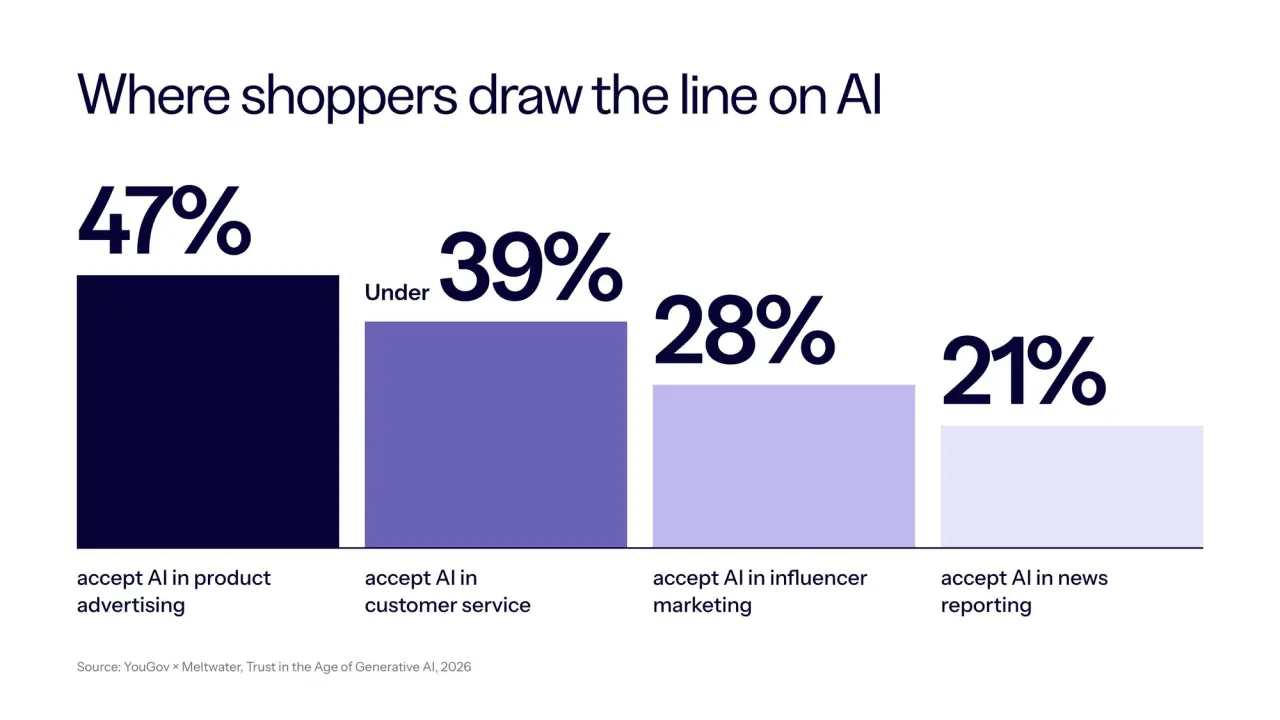
Consumers don't reject AI across the board. They judge it by where it shows up. YouGov found that 53% accept it in entertainment and 44% in educational content, but acceptance drops sharply once AI starts speaking on a brand's behalf.
The brand penalty
The more AI replaces people, the harder shoppers push back. Nearly half (49%) said their trust would fall if AI replaced human creators entirely, and 63% said it would drop if a brand's AI use felt misleading. The Nuremberg Institute for Market Decisions tested this by showing people identical ads and telling half of them the image was AI-generated. The "AI" version was rated less credible and less emotionally engaging, and fewer people wanted to click through. The bias was weaker for high-tech products and stronger for traditional ones. That matters for Shopify merchants: if you sell baked goods, clothing, flowers, or homeware, your customers may be the least forgiving audience of all.
Customer service needs a human exit
Five9's 2026 survey of 3,000 consumers in the US, UK, and Germany shows exactly where the line sits in support. Just over half trust AI to handle order and account status accurately, but fewer than a quarter trust it to approve refunds, and only 18% think it can handle complex or sensitive issues. 55% said they'd trust AI if there's a clear way to reach a human, and just over half are less likely to buy from a company that doesn't offer one. The handoff itself needs work, too: 87% are already frustrated by the time they're switched to a person, often because they have to repeat themselves. A WhatsApp Business and Kantar study of more than 11,000 consumers across 22 markets adds that 79.3% want signs of legitimacy before they'll use an automated channel at all.
The transparency dilemma
Shoppers want to know when AI is involved: 86% say disclosure is important, and 59% say a lack of it reduces trust. Hiding it is risky, because while 58% believe they can spot AI-generated content, 87% worry that people will struggle to tell what's real. Undisclosed AI is always one sharp-eyed customer away from becoming a story. But NIM's experiments show that a label alone doesn't win trust back either.

The trust signal no algorithm can fake.
What this means for your Shopify store
The research doesn't say "stop using AI." It says be deliberate about where shoppers meet it. Here's how to put that into practice.
Use AI backstage, keep the storefront human
The trust penalty shows up where AI faces the customer, not where it helps you run the business. Drafting product descriptions you'll edit, tagging customers, building automations, and analyzing sales are all low-risk uses, and they're exactly what Shopify's own AI tools are built for. The hours you save can go into the parts of your store customers actually see.
Show the people behind your store
Across both years of research, human involvement is the strongest trust signal. Use real photos of your products, your team, and your space, let your founder story and voice come through, and feature reviews from real customers. If you sell traditional products, this matters even more. Never fake social proof, because nothing breaks trust faster than a review that turns out to be invented.
Disclose where it changes what customers believe
You don't need a label on every email. Disclosure matters most where AI affects what a shopper thinks they're getting, such as AI-edited product images, virtual try-ons, or an AI assistant answering questions. A short, plain line like "Our assistant is AI-powered. Tap here to talk to our team" meets the expectation without making a drama of it.
Automate the simple questions, keep people for the rest
Order status and store hours are fair game for automation. Refunds, complaints, and anything emotional should go to a person, with a visible way to reach them and a handoff that carries the conversation across, so customers never have to start over.
Be upfront about customer data
If you use AI tools that touch customer information, say so in plain language in your privacy policy and at checkout where relevant. With data worries carrying from one holiday season into the next, being upfront is a real way to stand out.
Trust is the advantage
Between 2025 and 2026, shoppers came to rely on AI more while trusting it less. The research is clear about which brands come out ahead.
For Shopify merchants, that's good news. The tools that save you hours are already built into your admin, and the human touch your customers are asking for is something you already have.
Share this post